Map where planetary energy peaks — for any birth chart.
Astrocartography projects a natal chart onto the globe, revealing the places where each planet rises, sets, culminates, or rests beneath the Earth. The API returns planetary line coordinates ready for relocation maps, travel tools, and city insight engines.
“Four angles — Ascendant, Midheaven, Descendant, Imum Coeli — crossed by every planet in the chart. Each intersection marks a geographic zone of amplified influence.”
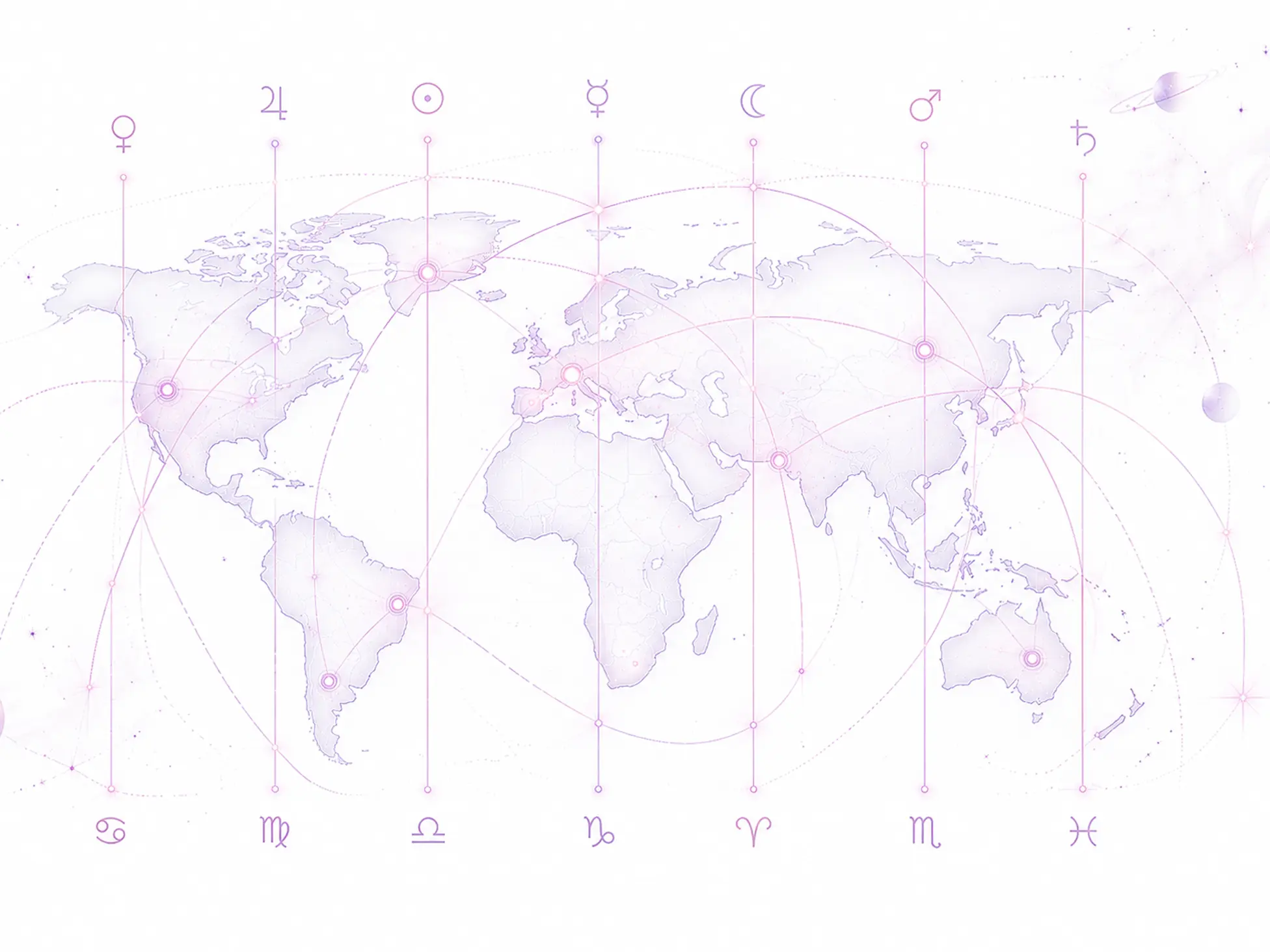
Engineered for astrocartography maps.
Three endpoints cover full planetary line plotting, life-category filters, and single-line relocation lookups — all with east-positive longitude coordinates and optional paran crossings on full maps.
East-Positive Longitudes
All ACG coordinates follow the east-positive convention — no sign confusion for your map renderer.
5° Latitude Steps
AC/DC curves sampled every 5° of latitude — smooth enough for production maps, light enough for fast rendering.
9 Life Categories
Filter the full map down to just love, career, money, health, spirituality, adventure, creativity, power, or communication lines.
Paran Detection
Find exact latitude crossings where two planetary lines meet — the most powerful spots on the map.
Zenith Latitude
Every planet includes its zenith_latitude_deg — where it is directly overhead on the globe.
Single-Line Isolation
Need just Moon-MC? Call one endpoint and get exactly that line — no parsing through the full response.
Map-Agnostic Output
Returns raw lat/lng coordinates — works with Mapbox, Leaflet, Google Maps, D3, or any canvas renderer.
Understanding ACG angles.
Every planet in your chart produces four lines on the map — one for each angular position. MC and IC are vertical meridian lines (straight up and down). AC and DC are curved lines that wind across the globe following the horizon.
The angle determines which area of life that planet's energy influences at a given location. Together, the planet + angle combination explains what a city, route, or relocation zone may activate for the chart owner.
Ascendant
Identity, self-expression, and how others perceive you at that location. The rising line. Highlights confidence, presence, and first impressions.
Midheaven
Career, public reputation, ambitions, and achievements tied to that place. The overhead meridian. Amplifies growth, reputation, and career opportunity.
Descendant
One-on-one relationships, partnerships, and significant connections at that location. The setting line. Strengthens attraction, harmony, and close bonds.
Imum Coeli
Home, family, emotional roots, and private life connected to that place. The underfoot meridian. Supports belonging, family, privacy, and emotional safety.
How to read an Astrocartography map.
Each relocation line connects a planet to an angle. The planet tells you what energy is active; the angle shows whether that place emphasizes identity, career, relationships, or home life.
Venus / Descendant
Best places for love & romance
Jupiter / Midheaven
Best places for career growth
Moon / IC
Best places to feel at home
Sun / Ascendant
Best places for confidence & identity
Venus / Descendant
Locations where themes of love, harmony, beauty, and magnetic attraction are amplified within your closest relationships. People often meet significant partners or experience deepened romantic connections near this line.
Use this line to rank destinations where relationship chemistry, client rapport, and social ease may become more visible.
EXPLORE THE APIs
Pick an ACG endpoint. See the map response.
Preview the exact request and JSON your app can use to draw planetary lines, themed locations, or a single relocation line.
1curl --request POST \
2  --url https://json.astrologyapi.com/v1/acg/travel \
3  --header 'x-astrologyapi-key: YOUR_API_KEY' \
4  --header 'Content-Type: application/json' \
5  --data '{
6    "day": 22,
7    "month": 8,
8    "year": 1999,
9    "hour": 18,
10    "min": 50,
11    "second": 0,
12    "tzone": 5.5,
13    "lat": 19.0759837,
14    "lon": 72.8776559,
15    "include_parans": false
16 }'Launch astrocartography maps without ephemeris infrastructure.
One API computes planetary positions, projects angle lines onto the globe, filters by life category, and returns optional paran crossings for full relocation maps — your app turns the coordinates into guidance.
Astrocartography FAQs
Astrocartography — also called locational astrology — projects your natal chart onto the globe. It calculates where each planet was angular (rising, setting, overhead, or underfoot) at your birth and draws those positions as lines on a world map. Places near those lines amplify that planet's themes for you.
These are the four angles. AC (Ascendant) is where the planet was rising — affects identity and first impressions. MC (Midheaven) is where it was overhead — relates to career and public life. DC (Descendant) is where it was setting — governs relationships. IC (Imum Coeli) is where it was underfoot — connects to home and roots.
Standard birth details: day, month, year, hour, min, tzone, lat, and lon. The optional second field improves precision, and include_parans can be set to true on the travel endpoint.
Parans are latitude crossings where two different planetary lines intersect on the map. These points are where both planets are simultaneously angular — considered especially potent locations that blend both planets' influences together.
The category endpoint supports: ADVENTURE, CAREER, COMMUNICATION, CREATIVITY, HEALTH, LEARNING, LOVE, MONEY, POWER, RELATIONSHIP, SPIRITUALITY, SUCCESS, TRANSFORMATION, TRAVEL, VITALITY, and WEALTH. Each maps to specific planets and returns only those lines.
All coordinates use east-positive longitude convention. AC/DC lines return arrays of {latitude_deg, longitude_deg} points sampled at 5° latitude steps. MC/IC lines return a single longitude_deg since they are vertical meridians.
Yes. The /planetary-line/:category/:planet endpoint accepts an angle category such as MC, IC, AC, or DC plus a planet such as MOON or SUN, then returns only that single line.
The API returns raw latitude/longitude coordinates that work with any map renderer — Mapbox, Leaflet, Google Maps, D3.js, or custom canvas implementations. No vendor lock-in.